
Tuesday, November 17, 2009

Training Dogs to Alert

A little while ago, we received an excellent question on Twitter from @mrlent about training dogs to alert for a fainting condition caused by heart rate. (See his original question here.) Our answer is going to take a few more characters than the 140 limit on Twitter, so we thought we would post it here.

Dogs have an amazing ability to respond to extremely subtle stimuli, sometimes so subtle that neither humans nor machines can pick up on them. It will seem like the dog is alerting to a condition. However, the dog is technically responding.

You may have heard of Diabetic Alert Dogs, and even though they have the word “alert” in their name, they are still responding to a stimulus, in this case an odor that the body produces when blood sugar drops. These dogs are trained to perform specific behaviors when they smell that particular odor.

Dogs that “alert” for seizures are also fairly well known. These dogs perform a behavior before a medical crisis arises, sometimes signaling their partner when a seizure is going to occur. However, these dogs are still responding to something, not alerting. We just aren’t sure what the dogs are responding to, which makes it seem like they’re alerting.

A dog could be trained to respond to a fainting condition. We have actually trained and placed several dogs with individuals whose primary disability involved fainting or loss of consciousness. A dog could easily be trained to retrieve a telephone, pull an emergency cord, cover the person with a blanket, dial 911, alert someone else in the house, etc. The only way a dog could be trained to alert to a condition would be if the person knows of specific things that usually occur before he or she loses consciousness. It is possible to train the dog to respond to these things, thereby creating an “alert” before the person faints.

Some of the dogs we have trained to respond to a fainting condition have developed alert behaviors. However, they are still technically responding to something – we as human just aren’t able to perceive what they are responding to. In order to train a dog to perform a behavior, we need to be able to perceive specific cues or stimuli.

Friday, November 6, 2009

Service Dogs: Specially Trained Partners

In early September, we held our Meet the Dogs sessions where several people who had been on our waiting list got to meet the dog that would become their partner. Since then, we have been specially training each of those dogs for each person, so that when the service dog teams graduate, the dogs are able to assist their partners with their unique needs.

We’re dedicated to making sure that we are meeting the needs of each person who receives a service dog from us. When we’re matching people with a dog, we learn as much as we can about that person’s unique needs so we can specially train the dog. For example, one person may need to use the dog for balance as he moves. Because everyone gets around differently, we will fit a dog with a harness and have the person try using the dog as balance at our Meet the Dogs sessions. This gives the person the opportunity to find out how the dog will be able to assist him with balance. Also, because there are several different types of harnesses a balance dog can wear, this short demo allows the person and dog to find the type of harness that works best for them. From a training standpoint, it gives us the opportunity to observe how the person is walking or moving with the dog. In advanced training, we will then try to duplicate some of those movements so the dog is specially trained to do balance work with their partner.

Similarly, we sometimes need change the name of a dog in order to meet a person’s needs. Each litter that we breed and raise is assigned a theme, and each puppy is named according to that theme. For example, our most recent litter is called the Crayon litter, and each puppy is named after a crayon color. However, when a person is matched with a dog, we may need to change the dog’s name for that person. For instance, we have placed several hearing dogs with people who are deaf or hard of hearing. Sometimes, because of their disability, the dog’s name may be difficult for the person to pronounce. We will then change the dog’s name for that person. Changing a dog’s name is not as difficult as it may seem. It is simply a matter of training the dog to respond to a different name. And something as simple as a name can mean all the difference to that dog’s human partner.

If you would like to read more about how we match people with dogs, please read our Meet the Dogs post.

Since 1994, 171 service dog teams have graduated from our program, and we currently have 26 puppies being raised by our wonderful, dedicated volunteers. As a fully accredited service dog organization, we are dedicated to high standards of quality and making sure that our service dogs are able to assist their partners with their unique needs. We love our work, and we’re looking forward to the day when the dogs that are currently in advanced training graduate with their new partners as working service dog teams.

Tuesday, October 27, 2009

A Night for the Dogs: Black Tie & Tails

Dogs strutted around the ballroom in their finest evening wear. They held their heads high, as if they knew they were the guests of honor.

Our 6th annual Black Tie & Tails was a fun and charming evening for both our human and canine guests.

The women dressed in elegant gowns and dresses and the men wore their best suits or tuxedos. One gentleman even wore a full kilt. The dogs also dressed for the occasion, in bowtie collars, satiny and glittery skirts – even a red feather boa. The gala began with the reception, where guests enjoyed hors d’oeuvres, had their photos taken and had their caricatures drawn by Neil McMillin to commemorate the occasion.

Guests mingled, meeting new friends and catching up with old ones. Dogs’ tails wagged and they sniffed each other, getting acquainted. Some of these dogs have come to Black Tie & Tails for several years, and we love seeing our old friends again. One owner commented that her dog gets really excited for Black Tie & Tails, and with good reason. These dogs are guests of honor.

video

At the beginning of the night, each dog was formally announced by Flora Posteraro of ABC27, our mistress of ceremonies. The dogs pranced across the dance floor as their names were announced, showing off their evening wear and perfect grooming. There were black, yellow and chocolate labs, a golden retriever, a corgi, St. Bernards, a Great Dane, and many others.

During dinner, each dog relaxed at their owners’ feet and enjoyed a delicious doggie dinner provided by Doggy Delights. The dogs loved their dessert – Frozen Woofys! Watch a video of SSD Rossi enjoying her Banana Rama Ding Dog Frozen Woofy. Rossi is a demo/interview/therapy dog for SSD.

video

Linden seemed to enjoy being in the limelight while she ate her dessert:

video

Our human guests enjoyed a delicious dinner, silent auction, live auction and live jazz music provided by Andrew Bellanca and friends. Items auctioned at the live auction included vacations in Annapolis, Florida, and Loon Lake; a cocktail party; and the rare opportunity to name an SSD puppy.

Black Tie & Tails benefits SSD, and we would like to thank all of our guests and sponsors for attending and supporting us, as well as the Sheraton Harrisburg-Hershey Hotel for providing such a lovely venue. It is with your support that we are able to provide service dogs to assist people to become more independent. With your support, we are able to change lives.

We hope you had a lovely evening with your canine companion. We know we enjoyed it!

Thursday, October 22, 2009

Dressed for Success

Susquehanna Service Dogs Rusty, Shamrock, Lavender, Onyx, Copper, Slate, Jade, Denim and Sienna are dressed for success! Those purple things they’re wearing are puppy-sized harnesses.

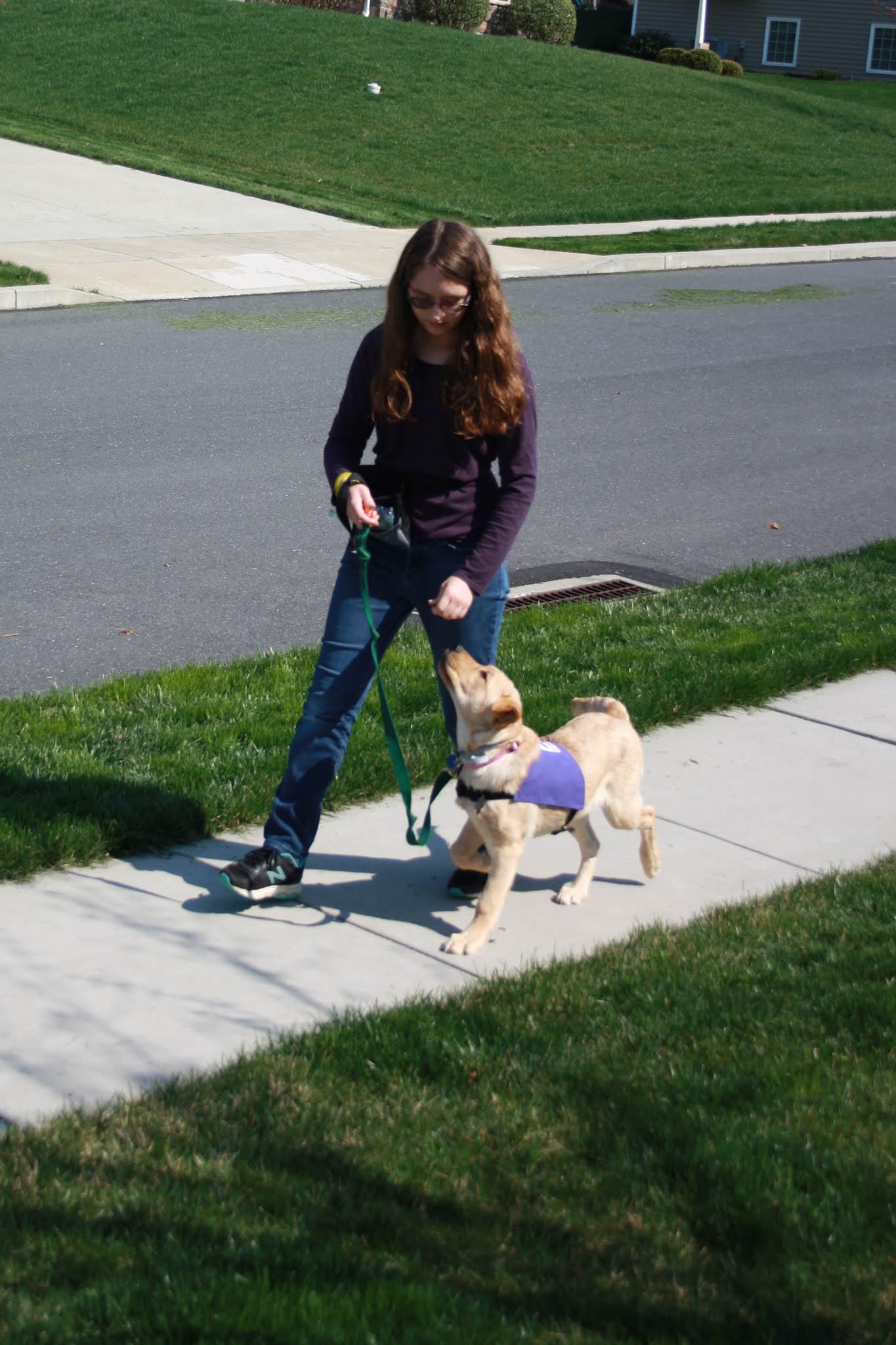
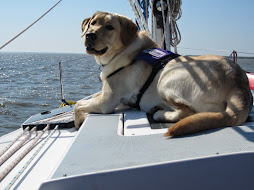
All of our service dogs wear harnesses to show that they are a service dog or service dog-in-training. (For SSD, a purple harness means the dog is still in training. A green harness means the dog is a working service dog that has been placed with a partner.) However, having the puppies start wearing them this young is something new for us. If you watched the Hill Top Litter last November, you probably noticed that the puppies did not wear harnesses. With the Crayon Litter, we decided to get the puppies used to their harnesses early. By the time these puppies are grown, they’ll have changed harnesses five times!

We have a very specific reason for dressing the puppies in their harnesses so early. Their mom, SSD Winter, is very sensitive to her harness. If possible, she prefers not to wear it. Harness sensitivity is a trait that the puppies can inherit. We’ve seen it in puppies as young as eight weeks old.

What’s so bad about a dog that’s sensitive to his harness? Nothing is “bad,” really. It does limit the dog’s placement options, though. A dog with harness sensitivity will not be able to be a balance dog because balance dogs wear a special harness that partners hold on to. Also, since the dogs don’t necessarily need to wear their harnesses while they’re at home, partners may need to dress the dog when they go out in public. A dog with harness sensitivity would not be able to be placed with an individual who uses a wheelchair, especially if that person is going to be dressing the dog. It wouldn’t take the dog long to figure out that if he doesn’t want to wear his harness, he just needs to stay out of arm’s reach. A service dog would not be doing his job of assisting his partner to be more independent if that partner has to have someone else put the harness on the dog.

Additionally, dogs that do not like their harness are a little more challenging to train. For example, if a dog doesn’t like his harness, he will tend to do a “sphinx” down rather than a relaxed down, meaning he may hover or not roll onto his hip. Additionally, dogs with harness sensitivity may not like to walk on strange surfaces. Both the relaxed down and walking on strange surfaces are important skills for service dogs.

By having the puppies wear their harnesses at such an early age, we’re hoping they do not develop harness sensitivity. So far, things are looking good!

Here's a video from a few weeks ago of the puppies playing in their harnesses: http://www.ustream.tv/recorded/2308177

Tuesday, October 6, 2009

Puppies Say "Yum!" to Puppy Food!

It didn't take the puppies long to figure out that the mush in front of them was food. Soon after we plunked them down in front of a plate of softened puppy food, they dug right in, eating like champs.

A little over a week ago, the puppies ate their first meal of "real" food, beginning the process of weaning. We soaked puppy food in water to soften it into a gruel, then served it to the puppies. Because this was the first time they were eating real food, we fed one puppy first. Shamrock was the lucky first puppy to eat his meal. At first, he wasn't entirely sure what to make of the new food, and he licked the edges of the plate. But once his caretaker scooped a little food on her finger and let him lick it off, Shamrock got the idea and dug in.


video

After that, we fed three puppies at a time so we could watch them and more easily monitor how much they were eating. Until they got the hang of eating, we actually stuck their front paws in their food, which seemed to help them realize that there was tasty food in front of them. Watch a video of Jade, Denim and Copper chowing down:

video

The puppies even licked up the food that fell off the plates onto the blanket!

We feed the puppies a lamb-based puppy food, recommended by the vet because it will help avoid allergies later. The puppy food must also contain DHA, which is important for brain and eye development and can help them learn more quickly and enhance their memory. While SSD Winter was pregnant and later while she was nursing, she ate puppy food so the puppies would receive the nutrients through their mom.

All of our food comes from Abrams & Weakley.

You can help us feed the puppies! As these puppies grow, they go through a lot of food. We provide food for our dogs while they're young puppies and while they're in the kennel. When they join their puppy raiser families, they go with a five pound bag of food. We also take care of any special veterinary diets. Additionally, when we place the dogs with their partners, we give the partners a 40 pound bag of food.

Donate to feed a puppy!

We hope you enjoy the videos and the puppy cam! We know we love watching them!

Monday, September 28, 2009

Live on the Puppy Cam: The Crayon Litter!

Our Puppy Cam is now live! You can watch Shamrock, Slate, Denim, Sienna, Onyx, Lavender, Copper, Jade and Rusty as they play and sleep. Just visit our website: http://www.ssdpuppycam.com to view the Puppy Cam.

As the puppies make their debut on the Puppy Cam, they are also reaching a milestone in their development. Today, they ate puppy food for the first time!

Look for a post soon about the puppies' reactions to their first "real" meal.
video

Tuesday, September 22, 2009

You're Invited to Tails from the Bark Side!

You’re invited to Tails from the Bark Side, a Howl-o-ween costume dinner dance to benefit SSD’s Northeast Puppy Raising Program!

When: 6 p.m. on Saturday, October 10, 2009

Where: VFW Post #3448
B. Gregory Krummell Memorial
440 Sterling Road
Tobyhanna, PA

Tickets: $25 per person (must be purchased by Sept. 28)

Tails from the Bark Side includes a 50/50 raffle, Chinese auction, music, food and costume prizes! Entertainment will be provided by Long Time Comin’. Costumes are optional.

To purchase tickets, please email pattydo65@hotmail.com.

Service dogs and any SSD dog are welcome!